Optimizing Gesture Recognition Firmware for Enhanced Hand Tracking in Augmented Reality Fitness Controllers
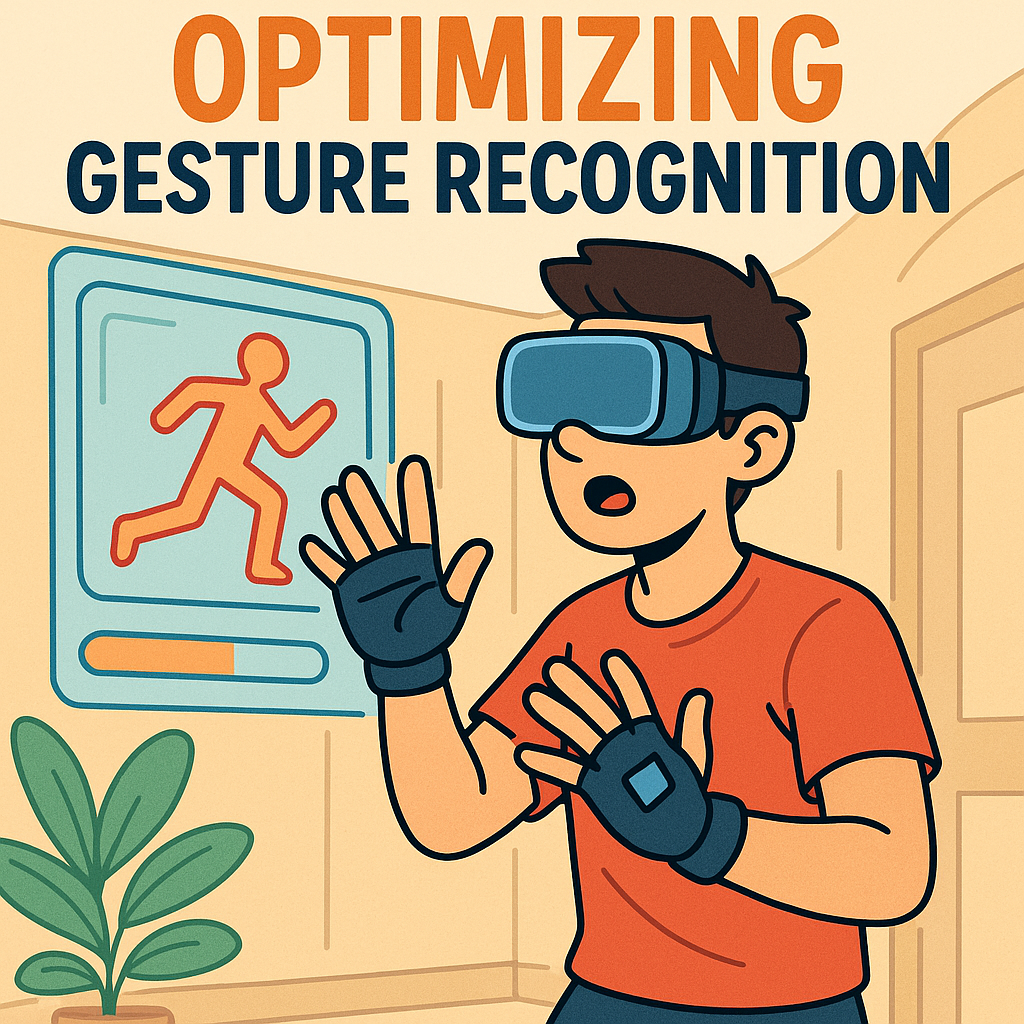
Understanding the Challenge of Gesture Recognition in AR Fitness Controllers
As the fitness industry continues to embrace augmented reality (AR), the need for low-latency gesture recognition firmware for hand tracking becomes paramount. The integration of gesture-based controls in AR fitness applications not only enhances user experience but also increases engagement. However, achieving accurate and responsive hand tracking in real-time poses several engineering challenges that need to be addressed.
Hardware Considerations: Sensors and Processing Units
The foundation of effective gesture recognition lies in the hardware selection. Most AR fitness controllers utilize a combination of inertial measurement units (IMUs), cameras, and sometimes even depth sensors. IMUs provide orientation and movement data, while cameras capture the visual context of hand gestures.
When selecting sensors, engineers must consider factors such as:
- Sampling Rate: Higher sampling rates yield more data points, which can improve accuracy but at the cost of increased processing load.
- Noise Levels: Sensors with lower intrinsic noise contribute to more accurate gesture detection, but they often come at a premium.
- Field of View: A wider field of view can capture more gestures but may introduce more background noise that needs filtering.
Firmware Design: Balancing Performance and Responsiveness
The firmware development phase is where many of the design decisions come into play. The primary goal here is to minimize latency while maximizing the accuracy of gesture recognition. Achieving this balance often involves fine-tuning algorithms that process sensor data.
One common approach is to implement a Kalman filter for sensor fusion. This algorithm can effectively combine data from the IMUs and cameras to produce a unified gesture output. However, the computational complexity must be managed. Engineers often have to make trade-offs between the depth of the filtering algorithm and the processing capabilities of the microcontroller.
For instance, a powerful microcontroller might handle a more complex model, resulting in better accuracy, but at a higher power consumption rate, which is detrimental for battery-operated devices. This necessitates decisions based on the target user profile—whether they prioritize precision over battery life or vice versa.
Algorithm Efficiency: Real-Time Processing
Gesture recognition algorithms must be designed not just for effectiveness but for efficiency. Classical machine learning methods can be computationally expensive, requiring significant power and processing time. In contrast, lightweight neural networks or decision trees can offer faster performance, albeit at the risk of reduced accuracy.
Engineers often resort to optimizing the algorithm’s architecture. Techniques such as quantization can reduce model size and computational demands without heavily sacrificing performance. For instance, converting floating-point operations to fixed-point can help in environments where processing power is limited, like in an embedded system.
Design Tradeoffs: User Experience vs. Technical Limitations
When designing gesture recognition for AR fitness controllers, user experience must be a central focus. If gestures are not recognized swiftly and accurately, users may become frustrated, undermining the immersive experience that AR aims to provide. This requires a thoughtful approach to how gestures are defined and processed.
Engineers often have to decide between a broad gesture vocabulary that allows for many commands or a narrower focus that ensures higher accuracy for each gesture. For instance, a controller that recognizes ten unique gestures might overwhelm the algorithm’s processing capabilities, leading to slower response times. Conversely, limiting gestures to three or four may simplify recognition but could hinder user interaction and engagement.
Feedback Mechanisms: Enhancing User Interaction
Incorporating haptic feedback can significantly enhance the user experience by providing real-time confirmation of gesture recognition. This feedback loop is crucial, especially in a fitness context where users are likely to be in motion. The firmware can be programmed to trigger specific vibrations or resistance feedback upon successful gesture recognition, thus reinforcing user actions.
The challenge here lies in the synchronization of feedback with the gesture recognition algorithm. Any delay in feedback can disrupt the user experience and lead to confusion. Therefore, the firmware architecture must ensure that feedback mechanisms operate within the same low-latency constraints as gesture recognition.
Real-World Implementation: Lessons from Prototypes
In the prototyping phase, engineers often learn valuable lessons about the interplay of design choices. Early iterations might reveal that certain gestures are too complex for real-time processing, prompting a reevaluation of gesture definitions or an enhancement of the hardware capabilities.
Testing in a real-world fitness environment is essential. Feedback from actual users helps identify unexpected challenges, such as gesture misinterpretation due to sweat or motion blur. These insights can drive iterative improvements, leading to a more robust firmware solution.
Ultimately, optimizing low-latency gesture recognition firmware is a multifaceted endeavor that requires careful consideration of hardware, firmware efficiency, algorithm performance, and user experience. Each decision made in the design process carries weight, influencing not only the technical feasibility but also the overall success of AR fitness applications.