
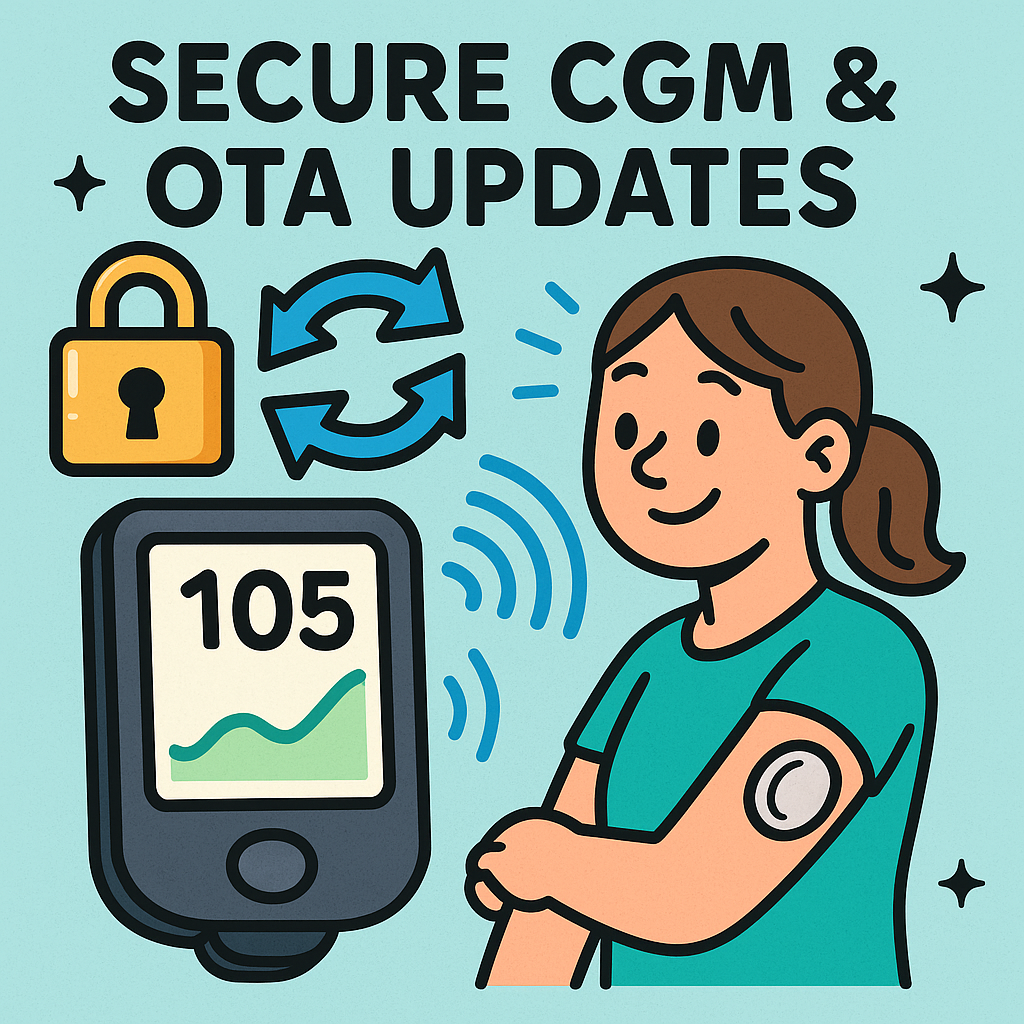
Understanding Secure Boot in Continuous Glucose Monitors
As the demand for continuous glucose monitoring (CGM) systems grows, the need for enhanced security features becomes paramount. These devices, particularly those enabled with Bluetooth Low Energy (BLE), are continuously transmitting sensitive patient data. Implementing secure boot is one of the first steps in creating a robust security architecture that protects this critical information from various attack vectors.
Secure boot ensures that a device only runs firmware that is verified and trusted. In the context of a CGM, this means that each time the device powers up, it checks the integrity of its firmware, preventing unauthorized code from executing. This verification process typically uses cryptographic signatures to confirm that the firmware has not been tampered with.
However, the implementation of secure boot is not without its challenges. One key consideration is the balance between security and performance. Traditionally, cryptographic operations can introduce latency, which is detrimental in a medical device that requires real-time data processing. Therefore, engineers must select lightweight cryptographic algorithms that maintain a high level of security without compromising the responsiveness of the device.
Challenges of Firmware Integrity in BLE-enabled Devices
With BLE-enabled CGMs, the firmware integrity verification process must be efficient, especially as these devices are often battery-operated. The boot process should ideally take less than a second to ensure quick readiness for use. This introduces design trade-offs; for instance, using a more complex hashing algorithm might provide better security but at the cost of speed and power consumption.
Another challenge arises from the need to store cryptographic keys securely. Storing these keys in non-volatile memory can expose them to physical attacks. Solutions such as hardware security modules (HSM) or secure enclaves can be used to safeguard these keys, but they add to the hardware complexity and cost. The choice of hardware thus becomes critical—engineers might lean towards microcontrollers with built-in security features to streamline the design process.
Implementing Over-the-Air (OTA) Updates Securely
Once secure boot is established, the next hurdle is implementing over-the-air (OTA) updates. OTA updates are vital for maintaining the security and functionality of CGMs without requiring physical access to the device. However, transmitting firmware updates wirelessly presents its own set of security challenges.
To ensure the integrity and authenticity of OTA updates, a secure channel must be established between the CGM and the update server. This often involves using transport layer security (TLS) to encrypt the data in transit. However, the overhead of TLS can strain the limited resources of low-power devices. Hence, engineers might opt for simplified versions of TLS or employ custom lightweight protocols designed specifically for constrained environments.
Furthermore, to mitigate risks associated with interrupted updates, a rollback mechanism should be in place. This means that if an OTA update fails, the device can revert to a previously secure version of the firmware. Implementing such mechanisms requires careful planning in the firmware architecture to ensure that versions are correctly managed and that the device can reliably switch back to a stable state without user intervention.
Real-World Design Trade-offs
Throughout the design process, engineers must continuously weigh the trade-offs between security, usability, and cost. For example, while a more sophisticated secure boot process offers enhanced protection against attacks, it might complicate the user experience during initial setup or updates. User experience is crucial in medical devices, where patients may not be technically savvy.
Another design consideration involves regulatory compliance. Medical devices must adhere to strict guidelines set forth by organizations such as the FDA. This means that any security features implemented must not only be effective but also demonstrably safe and reliable. This adds an additional layer of complexity in the design phase, as engineers must document and validate each security feature to meet regulatory standards.
Ultimately, the goal of implementing secure boot and OTA updates in BLE-enabled CGMs is to foster trust and reliability in the device. Patients need assurance that their data is secure, and that they can receive updates that enhance their device’s functionality without introducing vulnerabilities. As engineers, navigating these complexities requires a deep understanding of both the technology and the real-world implications of our design choices.