Low-Latency Energy-Efficient Embedded Hardware for V2X Post-Quantum Cryptography
Introduction
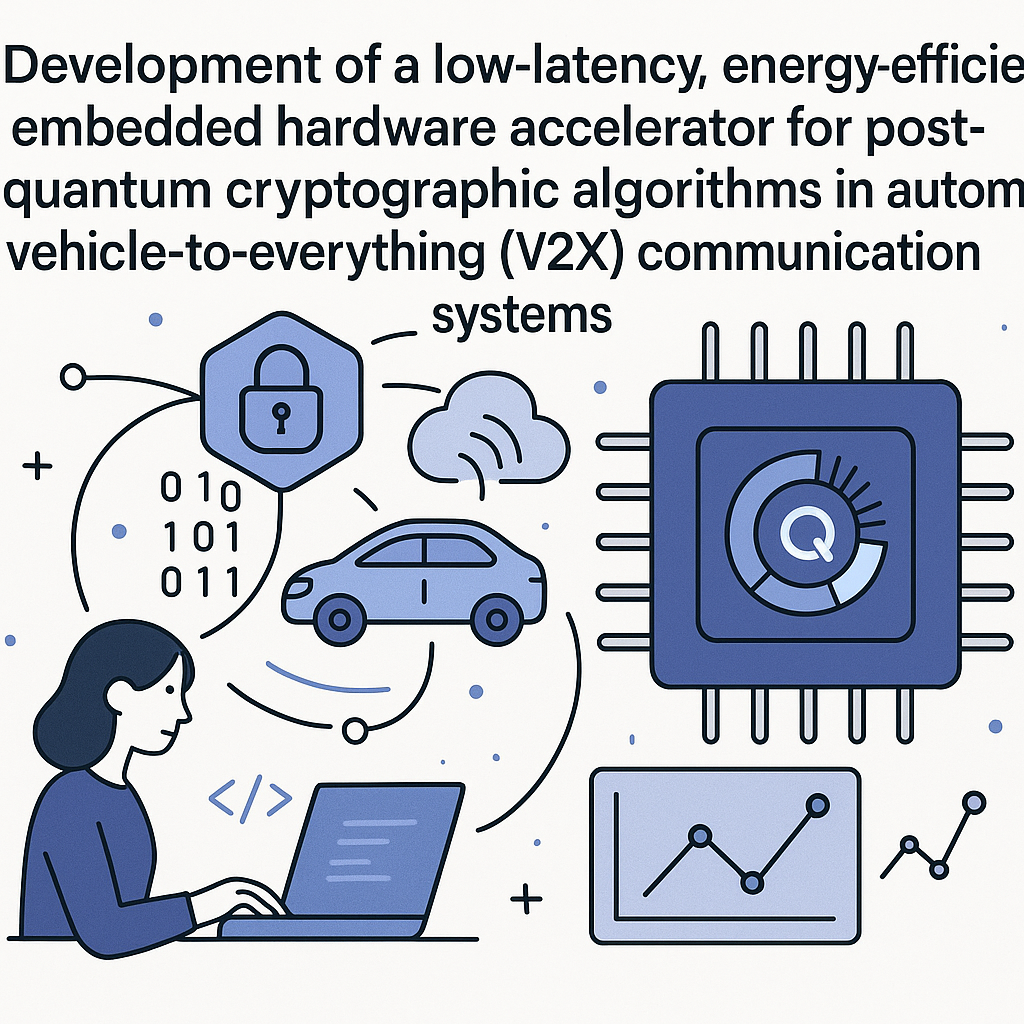
The rapid evolution of automotive technology has ushered in a new era of connectivity, particularly with the advent of Vehicle-to-Everything (V2X) communication systems. As vehicles increasingly communicate with their environment, the need for robust security measures becomes paramount. One critical aspect of this security is the implementation of post-quantum cryptographic algorithms, which are designed to withstand the potential threats posed by quantum computing. In this blog post, we will explore the development of a low-latency, energy-efficient embedded hardware accelerator specifically tailored for post-quantum cryptographic algorithms in V2X communication systems.
Understanding V2X Communication
V2X communication encompasses various types of communication in the automotive ecosystem, including:
- Vehicle-to-Vehicle (V2V): Direct communication between vehicles to share information about speed, location, and traffic conditions.
- Vehicle-to-Infrastructure (V2I): Interaction between vehicles and traffic management systems, such as traffic lights and road signs.
- Vehicle-to-Pedestrian (V2P): Communication with pedestrians to enhance safety and awareness.
- Vehicle-to-Cloud (V2C): Data exchange with cloud services for analytics and processing.
To secure these communications, robust encryption methods are essential, especially as the threat landscape evolves with advancements in quantum computing.
The Need for Post-Quantum Cryptography
Traditional cryptographic algorithms, such as RSA and ECC, are vulnerable to quantum attacks. This necessitates the development and implementation of post-quantum cryptography (PQC), which includes algorithms that can resist quantum computing threats. Key characteristics of PQC include:
- Increased Security: Designed to be secure against both classical and quantum attacks.
- Efficient Performance: Must perform well in real-time applications, especially in V2X systems.
- Low Resource Requirement: Must be suitable for embedded systems with limited computational power and energy constraints.
Challenges in Implementing PQC in V2X Systems
Integrating post-quantum algorithms into V2X communications presents several challenges:
- Latency: Low-latency communication is critical in vehicular networks to ensure timely data exchange.
- Energy Efficiency: Automotive systems are often constrained by energy resources, making energy-efficient solutions necessary.
- Scalability: The solution must be scalable to accommodate different vehicle types and communication loads.
- Compatibility: Must work seamlessly with existing communication protocols and infrastructure.
Designing a Low-Latency Hardware Accelerator
The development of a low-latency, energy-efficient embedded hardware accelerator involves several key steps:
1. Hardware Architecture
The first step is to design a hardware architecture that can efficiently execute post-quantum algorithms. This includes:
- FPGA or ASIC Implementation: Utilizing Field Programmable Gate Arrays (FPGAs) or Application-Specific Integrated Circuits (ASICs) for optimized performance.
- Parallel Processing: Implementing parallel processing capabilities to enhance throughput and reduce latency.
- Memory Management: Efficient memory management strategies to minimize access times and energy consumption.
2. Algorithm Selection
Choosing the right post-quantum algorithms is crucial. Some promising candidates include:
- lattice-based cryptography, known for its strong security foundations.
- code-based cryptography, which offers efficient key generation and encryption.
- multivariate polynomial cryptography, providing compact keys and fast computations.
3. Energy Optimization Techniques
To ensure energy efficiency, various optimization techniques can be employed:
- Dynamic Voltage and Frequency Scaling (DVFS): Adjusting the operating voltage and frequency based on workload requirements.
- Power Gating: Turning off unused hardware blocks during idle periods to save energy.
- Efficient Clock Management: Implementing clock gating to reduce power consumption during inactive states.
Testing and Validation
Once the hardware accelerator is developed, extensive testing and validation are essential:
- Performance Testing: Measuring latency, throughput, and energy consumption under various conditions.
- Security Testing: Conducting vulnerability assessments to ensure the resilience of the implemented algorithms against potential attacks.
- Interoperability Testing: Ensuring compatibility with existing V2X communication protocols and systems.
Conclusion
The development of a low-latency, energy-efficient embedded hardware accelerator for post-quantum cryptographic algorithms is a critical step towards securing V2X communication systems. By addressing the challenges of latency, energy consumption, and compatibility, this innovative solution will enhance the security of connected vehicles, paving the way for a safer and more secure automotive future. As the automotive industry continues to embrace advancements in technology, prioritizing robust security measures will be essential in building trust in V2X systems and ensuring the safety of all road users.