
Understanding Real-Time Data Processing in Firmware Stacks
In the realm of autonomous farming, the integration of private 5G edge nodes has transformed how data is collected, processed, and utilized. The challenge, however, lies in optimizing real-time data processing within the firmware stacks of these nodes. The firmware acts as the critical intermediary between hardware capabilities and application-level functionalities, dictating how efficiently data can be managed.
The Hardware Landscape
At the core of these systems, we typically find a blend of advanced processors, specialized sensors, and communication modules. For instance, ARM-based processors are often chosen for their power efficiency and processing capabilities. These processors must handle data from various sources like GPS, LiDAR, and cameras, all while maintaining low latency and high reliability.
However, the hardware alone does not determine success; the firmware must be meticulously designed to leverage these hardware capabilities. This includes optimizing interrupt handling, memory management, and data serialization techniques to ensure that the firmware can process incoming data streams rapidly and reliably.
Challenges in Firmware Design
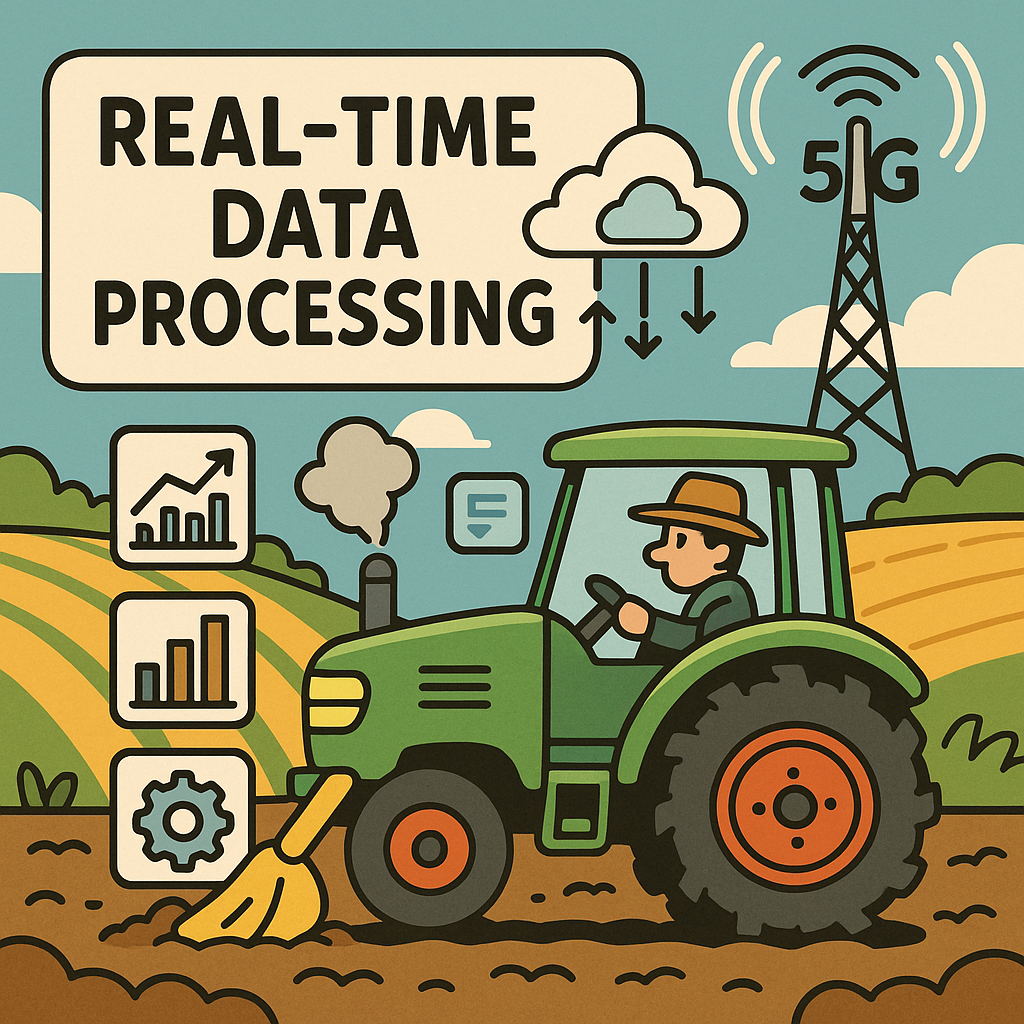
One of the primary challenges in optimizing firmware for real-time processing is managing the trade-off between latency and throughput. For example, consider a scenario where a tractor equipped with multiple sensors is navigating a field. The data from these sensors must be processed in real-time to make immediate adjustments to speed, direction, and other operational parameters.
Latency can be affected by several factors, including the number of data sources, the complexity of the processing algorithms, and the available bandwidth. In scenarios where multiple edge nodes are communicating simultaneously, the firmware must be adept at prioritizing critical data while ensuring less urgent data does not congest the communication channels.
Algorithm Optimization
Algorithms play a pivotal role in real-time data processing. For instance, implementing a lightweight filtering algorithm can help reduce the volume of data that needs to be processed without sacrificing the quality of the insights derived. For instance, using Kalman filters for sensor fusion allows for a more accurate representation of the vehicle’s position and environment by merging data from different sensors effectively.
Moreover, machine learning models can be deployed at the edge for predictive maintenance or crop monitoring. However, these models must be optimized for the limited compute resources available on edge nodes. Techniques like model quantization and pruning can significantly reduce the computational footprint, enabling quicker inference times without drastically impacting accuracy.
Design Trade-offs and Decisions
Every design decision comes with its set of trade-offs. For example, the choice between using a real-time operating system (RTOS) versus a bare-metal approach must consider factors like development time, scalability, and resource constraints. An RTOS can provide advanced scheduling and resource management functionalities, but it may introduce overhead that could negatively impact real-time performance. Conversely, a bare-metal approach can yield lower latency but may require more extensive development efforts.
Another significant consideration is the communication protocol. While protocols like MQTT or CoAP are lightweight and suitable for IoT applications, they may not provide the necessary speed for critical real-time data transmission. Instead, implementing a custom binary protocol over UDP might be a better fit, allowing for faster message delivery with reduced overhead.
Real-World Applications and Insights
In practical applications, these firmware optimizations manifest in tangible benefits. For example, a fleet of autonomous tractors can communicate real-time data to a central management system, enabling farmers to monitor field conditions more accurately and respond to issues instantaneously. This capability not only increases operational efficiency but also ensures that resources like water and fertilizers are used more judiciously.
Moreover, the optimization of firmware in edge nodes facilitates the integration of advanced technologies such as drone surveillance and soil sensors, creating a seamless flow of information that enhances decision-making processes in agriculture.