Understanding IEC 62304 and Its Importance in Insulin Delivery Systems
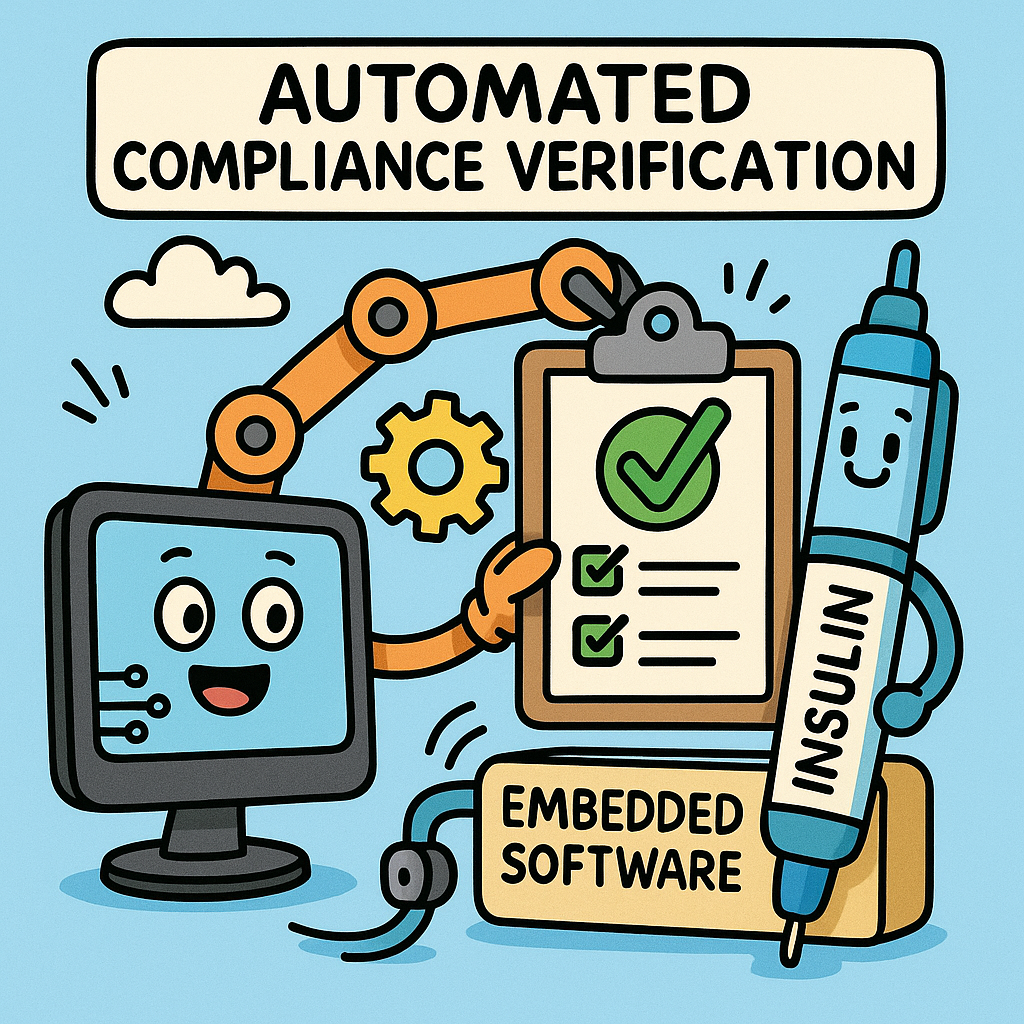
IEC 62304 is a critical standard that outlines the life cycle processes necessary for medical device software, especially in safety-critical systems like insulin delivery mechanisms. The standard emphasizes the need for rigorous documentation and adherence to defined processes to ensure patient safety. For developers and engineers, the challenge lies not just in understanding these requirements but in implementing them effectively within real-time systems that must operate reliably to manage insulin delivery.
The Challenge of Compliance Verification
Developing an automated compliance verification tool presents a unique set of challenges. The primary issues stem from the dynamic nature of embedded software systems and the need for real-time monitoring. In insulin delivery systems, any failure in software compliance could lead to severe health risks. Traditional manual verification processes are not only time-consuming but also prone to human error, which is unacceptable in this field.
Designing the Tool: Hardware and Firmware Considerations
When we set out to create this automated compliance verification tool, we had to consider both hardware and firmware constraints. The tool needed to integrate seamlessly with existing insulin delivery systems, which often utilize microcontrollers with limited processing power and memory. Our design focused on a lightweight verification engine capable of running alongside the primary control firmware without introducing latency.
- Hardware Selection: We opted for a low-power ARM Cortex-M series microcontroller that provided sufficient processing capability while meeting the energy constraints typical in medical devices.
- Firmware Architecture: The firmware was designed with modularity in mind, allowing us to isolate the compliance checking functions from the main insulin delivery algorithms. This separation was crucial for maintaining real-time performance.
Real-Time Monitoring and Algorithms
The heart of our compliance verification tool lies in the algorithms we developed for real-time monitoring. We designed a set of algorithms that could analyze the execution flow of the firmware against the IEC 62304 processes. This involved capturing runtime metrics, state changes, and software actions to ensure adherence to the defined processes.
- Event Logging: We implemented a non-intrusive event logging mechanism that records significant events in the software without affecting its performance. This data is crucial for real-time analysis and future audits.
- Static and Dynamic Analysis: Our tool employs both static code analysis techniques during the development phase and dynamic analysis during runtime to ensure continuous compliance verification. This dual approach allows for early detection of potential non-compliance issues before they escalate.
Design Trade-offs and Solutions
Throughout the development of this tool, we faced several design trade-offs that required careful consideration. One major decision was balancing the thoroughness of compliance checks with the system’s real-time performance. Insulin delivery systems must operate with minimal delay, so we prioritized lightweight checks that could run in the background without hindering the main software’s responsiveness.
Another trade-off involved memory usage versus the level of detail in compliance reporting. We chose to implement a hierarchical reporting system that captures essential compliance metrics while conserving memory. This approach allows us to provide actionable insights without overwhelming the system resources.
Challenges in Implementation and Future Directions
Implementing this tool in real-world scenarios posed additional challenges, such as ensuring compatibility with various insulin delivery systems and their unique software architectures. Moreover, as regulatory requirements evolve, our tool must adapt quickly to accommodate new standards. Continuous engagement with regulatory bodies and industry standards is necessary to keep the compliance verification tool relevant and effective.
Looking ahead, we envision enhancing our tool with machine learning capabilities to predict compliance issues based on historical data. This predictive approach could revolutionize how engineers approach software development in the medical device space, shifting from reactive compliance checks to proactive risk management.